
Mt Kent Observatory at 30 years
Updated: Sep 5
Brad Carter, Jonti Horner, Stephen Marsden, Ian Waite, Duncan Wright, and John Kielkopf
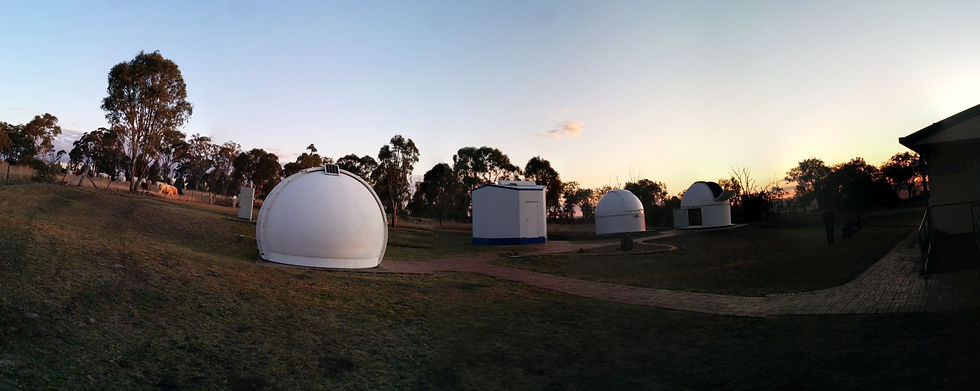
Telescope domes or enclosures at Mt Kent Observatory in August 2015. From left, the astrodome fibreglass version of the “Webb" dome (probably with a 16-inch (40-cm) Meade LX200 telescope), the octagonal “O’Mara” enclosure (probably with a Paramount ME robotic telescope mount with a Takahashi wide-field camera provided by Shared Skies), the dome (also known as the Louisville dome) of the Shared Skies CDK700 telescope, and finally the dome (Arthur Page dome) of the Shared Skies CDK20 telescope at the far right. The last two are housed in Sirius Observatories fibreglass domes, made in Queensland. Due to the difficult nature of the black soil on the site, each of the four telescope sites has deep and substantive concrete foundations reaching the local bedrock. Photo Nick Lomb
July 2026 marks thirty years since the official opening of Mt Kent Observatory in Queensland, and from humble beginnings the facility has become a world-class Australian facility for exoplanet science and related research.
The flyer for the opening event in July 1996 notes that astronomy at Mount Kent Observatory has its origins in the early 1970's when Dr Phil Dobney took up the position of Head of Physics at what was then the Darling Downs Institute of Advanced Education (DDIAE) in Toowoomba, and arranged for the purchase of a 14-inch (35-cm aperture) Celestron telescope on a portable tripod. In 1978, the family of the late Mr Bertram Webb donated a metal dome (a reworked water tank) that he had built locally. Once reconditioned, this dome was installed on campus. During the 1980s, local light pollution became an increasing challenge, and a search was undertaken to find an alternative site. In this task, and in advancing the cause of astronomy at the institution in its early days, the key contributions of Mr Ken Mottram, the physics lab manager, and physicist, and later Dean of Science, Dr Hugh Avey, are noted.

A scan from the invitation to Mt Kent Observatory’s official opening showing the telescope enclosures on site in 1996. The communications tower in the background makes for an unusual feature of the hilltop site but has not impacted any of the scientific research observations.
A hilltop site at Mount Kent was identified as being conveniently and cost-effectively meeting the requirements for a university astronomy facility, and the present 1.6 hectare site was leased from a local landowner, with the Webb dome being moved on site in 1990. A telecommunications tower not far from the observatory compound does make for an unusual feature of the hilltop site, but has never impacted any of the research observations made, and conversely is the reason the site offered existing road, power and communications infrastructure. In 1992, the Educational Development Group, a Toowoomba-based charity, provided funds for the construction of a demountable lecture room/instrumentation building, and this was officially opened at Mt Kent in 1995 by Dr Robyn Williams of ABC Science Show fame.
In the meantime, in 1988 Ken Mottram and Dr Arthur Page met at an astronomy conference in New Zealand, and the idea was born that there should be astronomical collaboration between the DDIAE and the University of Queensland (UQ). Arthur Page was a highly respected amateur astronomer engaged in professional astronomical research work, and the recipient of an Honorary Doctorate from UQ. Astronomical Society of Australia members would also note that his name endures today through the society’s Berenice and Arthur Page Medal. This collaborative approach was supported by the UQ astronomers of the day, Drs Jim O’Mara and John Ross, as well as physicist and the incoming Head of the Department of Physics, Professor John Mainstone.
In 1990, the DDIAE transitioned first to the University College of Southern Queensland, a college of the University of Queensland, before becoming the University of Southern Queensland and known as “USQ” in 1992. In 1993 an agreement was signed for collaboration and resulted in Mt Kent Observatory being officially opened on 10 July 1996, by Prof Don Mathewson, a notable former Queenslander, who was previously Director of the Australian National University’s Mt Stromlo and Siding Spring Observatories. Mt Kent Observatory was unveiled to a large contingent of invited guests as part of the “PEP5” conference - the Fifth Conference on Photoelectric Photometry (PEP5), held at the USQ Toowoomba campus 7-11 Jul 1996, and known as a “Trans Tasman” joint Australia/New Zealand meeting. When opened, the Mt Kent site comprised the spacious EDG facilities building, and three telescopes nearby in new and widely separated (and symmetrically located) enclosures, as shown in the photograph above taken from the invitation to the event.

Conference photo from The Proceedings of the 5th Trans-Tasman Photoelectric Photometry Conference July 1996 (often abbreviated as PEP5) published in the Australian Journal of Astronomy, Volume 6 November 1996 p. 264. Front row starting from the left side: Martin Porter (UQ student at the time supervised by Jim O'Mara), Ian Waite (currently Adjunct Research Fellow UniSQ), Brad Carter (UniSQ), Arthur Page, Mike Bessell (Mt Stromlo), Dave Crawford (founder of what is now DarkSky International), Vis Visanathan (Mt Stromlo) and John Davis (University of Sydney). Other attendees included second row from right, Elaine Sadler (now Professor of Astrophysics, University of Sydney), John Perdrix (publisher of the Australian Journal of Astronomy) and Col Bembrick (geologist and amateur astronomer). At the left rear, Fred Watson (Astronomer-in-Charge of the Anglo-Australian Observatory).
When opened, Mt Kent Observatory hosted the following equipment:
(1) The 1970s vintage 35-cm aperture Celestron “Webb Telescope”, but with a new fibreglass dome from Colin Blumson’s Astrodomes workshop on Queensland’s Sunshine Coast;
(2) A dedicated new 35-cm “Robotic Telescope” that brought together a Celestron optical tube assembly, CCD camera, and a custom mount designed and constructed in-house at the University of Queensland (and inspired by other automated telescopes such as those at Fairborn Observatory in the USA). The telescope’s enclosure however has an unusual octagonal layout more reminiscent of large-aperture international optical telescopes, and was built by James Hardie industries (sans any asbestos it should be emphasised) in Brisbane, according to a design envisioned by Jim O’Mara, who also provided overall scientific and technical leadership for the Robotic Telescope’s development;

Arthur Page and the Tamborine telescope in 1996. Photo Peter Anderson
(3) A 40-cm aperture Cassegrain “Tamborine Telescope” for high time resolution photoelectric photometry and donated in its original form by Arthur Page, to UQ, where its optics and mount were upgraded prior to installation at Mt Kent. The telescope carried the Tamborine name given that it was originally housed at Arthur Page’s golf course-adjacent Mt Tamborine Observatory, where it provided optical support for the flare star research of Australian radio astronomy pioneer Dr Bruce Slee at the CSIRO. At Mt Kent, the telescope also gained a new Astrodome enclosure.

Interior shot of the Louisville dome with the Shared Skies CDK700 PlaneWave telescope, in August 2015. Photo Nick Lomb
Since its opening in 1996, Mt Kent Observatory has evolved greatly, and today hosts multiple CDK700 0.7m robotic telescopes for the MINERVA-Australis exoplanet science and SONG asteroseismology arrays, with the two accompanying research spectrographs in a dedicated modern building, and with multiple Shared Skies Initiative instruments courtesy of a longstanding collaboration between UniSQ and the University of Louisville in the USA. Also on site is a space object monitoring capability operated remotely by the DLR, Germany’s space agency, and the latest addition to the site is the “RAPTOR” 0.8m Astrosysteme Austria telescope currently used for MINERVA-Australis observations. Mt Kent Observatory thus has infrastructure for a future of productive robotic and remote-access time-domain science for astronomy and space research, and can efficiently support research training, teaching and outreach programs as needed. In conclusion, it seems likely that Mt Kent Observatory will continue on its upward trajectory in making contributions in the years ahead towards Australia’s observational astronomy efforts and supporting the nation’s priorities in space research.


Comments