
The 2026 History of Australian Astronomy Annual webinar program
Updated: Oct 1

Our second annual workshop will be held on Wednesday 18 November 2026, 2:00 to 4:30pm AEDT (UTC+11). It is open to members and non-members of the ASA and the Chapter and is free of charge, all you have to do is register.
Program
1:45 pm Attendees can join
2pm - 2:10 Introduction by Nick Lomb
2:10 - 2:30 Marcus Chown: Black hole discoverer whose name has vanished down a metaphorical black hole
2:35 - 2:50 Kerrie Dougherty: Up, Up and Away: early balloon-borne and sounding rocket astronomy in Australia
2:55 - 3:10 Jack Foster: How to use a transit telescope.
3:15 - 3:30 Richard de Grijs: How Australians Imagined Mars, 1875–1899
3:35 - 3:50 Harry Wendt: The Discovery of Radio Emission from Flare Stars
3:55 - 4:10 Fred Watson: Grubb Down-Under - A 160-year Scientific Odyssey
4:10 - 4:30 Discussion and closing remarks.
PROGRAM ABSTRACTS

Invited address by Marcus Chown
Title: Black hole discoverer whose name has vanished down a metaphorical black hole
Abstract: There have been three Nobel prizes for black holes. Yet none of the awards has acknowledged the co-discoverers of the objects: Louise Webster and Paul Murdin. This is the story of how, in 1971, Louise and Paul found themselves sharing an office in an octagonal turret of a 16th-century moated castle in the southeast England and how Louise became the co-discoverer of the black hole in Cygnus X-1, one of the most significant findings in the history of astronomy.
Bio: Marcus Chown is an award-winning writer and broadcaster. Formerly a radio astronomer at the California Institute of Technology in Pasadena, his books include The Ascent of Gravity, which was The Sunday Times Science Book of the Year; Breakthrough; Infinity in the Palm of Your Hand, What A Wonderful World; Quantum Theory Cannot Hurt You; Felicity Frobisher and the Three-Headed Aldebaran Dust Devil; and We Need to Talk About Kelvin and Afterglow of Creation, which were both runner-up for the Royal Society Book Prize. His latest book, A Crack in Everything, was described as “downright poetic” by the New York Times.
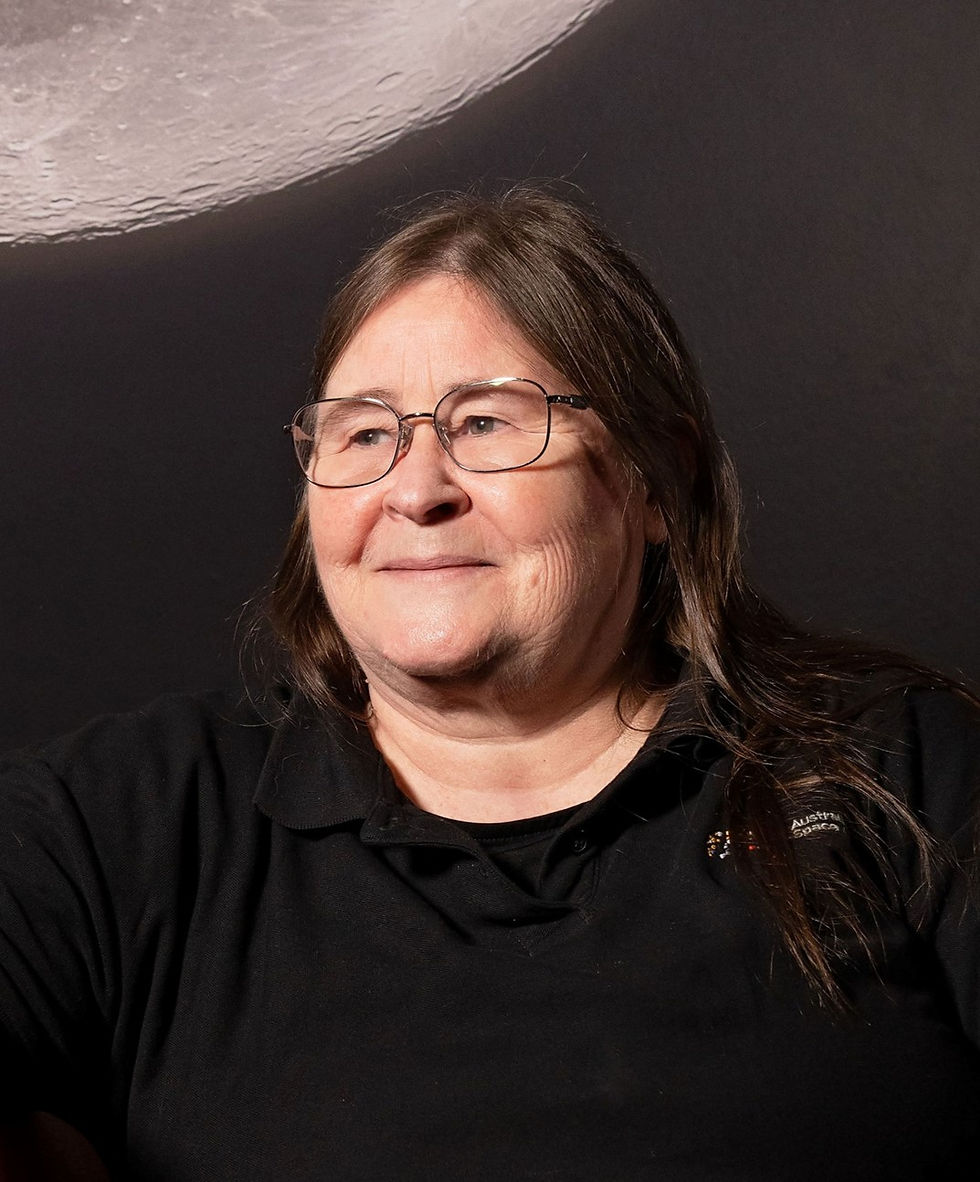
Kerrie Dougherty
Title: Up, Up and Away: early balloon-borne and sounding rocket astronomy in Australia
Abstract: Placing instruments into the upper atmosphere allows astronomers to study the cosmos in wavelengths largely blocked to ground observations. Even before the launch of the first satellites during the International Geophysical Year (1957-58), space astronomy commenced after World War 2 with the development of high-altitude balloons and sounding rockets. In Australia, University of Melbourne trailblazing female physicist Dr. Jean Laby pioneered scientific ballooning from the early 1950s, with the first Australian Balloon Launch Station established in Mildura in 1960. Later in the 1950s, the Weapons Research Establishment and the Royal Society’s Gassiot Committee developed sounding rockets that were launched from Woomera to support defence and civilian space research, including space astronomy. This presentation will outline the early history of space astronomy in Australia using balloons and sounding rockets, from 1950-1990. This period laid the foundations for local scientific ballooning and was associated with significant discoveries in X-ray astronomy.
Bio: Kerrie Dougherty OAM is Senior Heritage and Outreach officer at the Australian Space Agency. She is a space historian, curator, educator and outreach specialist. Kerrie is the author of Australia in Space, and an elected Member of the International Academy of Astronautics, serving on its History of Astronautics and Space Museums Committees. Between 2001 and 2024, she was a lecturer in the International Space University’s Space Humanities Department.

Jack Foster
Title: How to use a Transit Circle
Abstract: The Troughton & Simms Transit Circle that sits in the Transit Room of the Sydney Observatory has been sitting there since 1877. It was used for a little over 100 years for time determination and positional astronomy, but now it sits alone, unused, and misunderstood. In preparation for its upcoming 150th birthday on the 3rd of February 2027, this talk attempts to put the audience in the shoes of the observer and explain the step-by-step process one would follow to make an observation with the Transit Circle; because the greatest birthday present of all, is to be understood.
Bio: Jack Foster is a Project Assistant at the Powerhouse Museum. In this role, he researches the Sydney Observatory and the former functions of the site to assist with his development of Sydney Observatory's Conservation Management Plan—a document that will guide future decision making for the site. Jack once spent his birthday travelling for 3 hours via tram, train, bus, and funicular to an abandoned meridian marker of the Neuchâtel Observatory in Switzerland. That anecdote gives you an idea of the type of man Jack is—he likes his historic astronomical objects.

Richard de Grijs
Title: How Australians Imagined Mars, 1875–1899
Abstract: Between 1875 and 1899, Australian newspapers published more than a thousand articles about Mars. Drawing on a newly assembled database of colonial newspaper coverage, this talk examines how Australian readers encountered and interpreted one of the nineteenth century's most celebrated astronomical controversies: the putative canals of Mars. Far from merely reproducing overseas reports, Australian newspapers adapted, debated and often humorously reframed claims made by astronomers such as Giovanni Schiaparelli, Percival Lowell and William Pickering. The resulting coverage reveals a scientifically engaged colonial public that actively assessed astronomical ideas through local experience, engineering projects and everyday reasoning. This presentation explores how Mars became a cultural touchstone in the Australian colonies and argues that newspaper reporting offers a valuable window into the public life of astronomy in the decades before Federation.
Bio: Richard de Grijs is Professor of Physics and Astronomy at Macquarie University. Alongside his astrophysics research, he works on the history of astronomy and maritime science. His recent publications include studies of Mars in the Australian press, time signals and observatories, and biographies of William Dawes and Samuel Ward Flinders. He is Past President of Division C (Education, Outreach and Heritage) of the International Astronomical Union, is actively involved in heritage interpretation at the Australian National Maritime Museum and serves on the Board of the La Perouse Museum.

Harry Wendt
Title: The Discovery of Radio Emission from Flare Stars
Abstract: This talk examines how a Cold War satellite-tracking network, amateur astronomers in suburban Sydney, and two radio observatories a world apart proved that small red stars shout in radio waves. Could a star other than the Sun ever be detected at radio wavelengths? In the late 1950s, that question drove two independent research programs, one at Jodrell Bank under Bernard Lovell, the other at CSIRO's Division of Radiophysics under Bruce Slee, into a five-year hunt for radio bursts from flare stars: faint, magnetically active M-dwarfs capable of brightening by several magnitudes in seconds to minutes. Both efforts converged on the same conclusion, which was published in Nature within months of each other in 1963. This is a case study in parallel discovery, amateur-professional collaboration, and a pointed reminder of why primary-source history still matters, even (especially) in the age of AI.
Bio: Dr Harry Wendt is an Adjunct Research Fellow at the University of Southern Queensland, Centre for Astrophysics. He has a long-standing interest in early Australian radio astronomy. Harry has since published a series of papers based upon his thesis and subsequent research. He also co-authored the book Four Pillars of Radio Astronomy: Mills, Christiansen, Wild, Bracewell and is a member of the IAU Working Group on Historical Radio Astronomy and the History of Australian Astronomy Chapter of the Astronomical Society of Australia. Harry has a 28-year career in banking; he worked in the computer industry and spent eight years as an aircrew officer in the Royal Australian Navy Fleet Air Arm. His interest in astronomy was first kindled while learning to navigate using a sextant.

Fred Watson
Title: Grubb Down-Under -
A 160-year Scientific Odyssey
Abstract: In 1866, the 21-year-old Dublin engineer Howard Grubb embarked on his first major project – the 48-inch Great Melbourne Telescope (GMT). That ill-fated instrument was not only a milestone in Australian astronomy but also heralded a long series of successful optical telescopes manufactured in Ireland by the Grubb company and in Britain by its successor Grubb Parsons until the final closure in 1985. The last for Australia – the 3.9-metre Anglo-Australian Telescope (AAT) – was completed in 1974 and remains the nation’s largest. Astronomer Fred Watson is uniquely qualified to tell the story of the people who created Australia’s most significant optical astronomy facilities and propelled them to global prominence. Inspired by the GMT while still at school, he worked for Grubb Parsons in the 1960s on space- and ground-based telescopes, including preparations for the AAT. Twenty-five years later he became the AAT’s Astronomer-in-Charge after a research career using the company’s largest telescopes overseas.
Bio: Fred Watson AM is an honorary professor of astronomy advocacy and engagement at Macquarie University. From 2018 to 2024, he was the Australian Government’s first Astronomer-at-Large, having served for the previous 20 years as the Astronomer-in-Charge of the Australian Astronomical Observatory and before that working at Britain’s two Royal Observatories. He led several projects in advanced astronomical instrumentation and spectroscopic surveys and today is involved in both the history and future of Australian astronomy. He is perhaps best known in Australia for his award-winning radio and TV broadcasts, books, music and dark-sky advocacy – and internationally for the Space Nuts podcast.
Comments